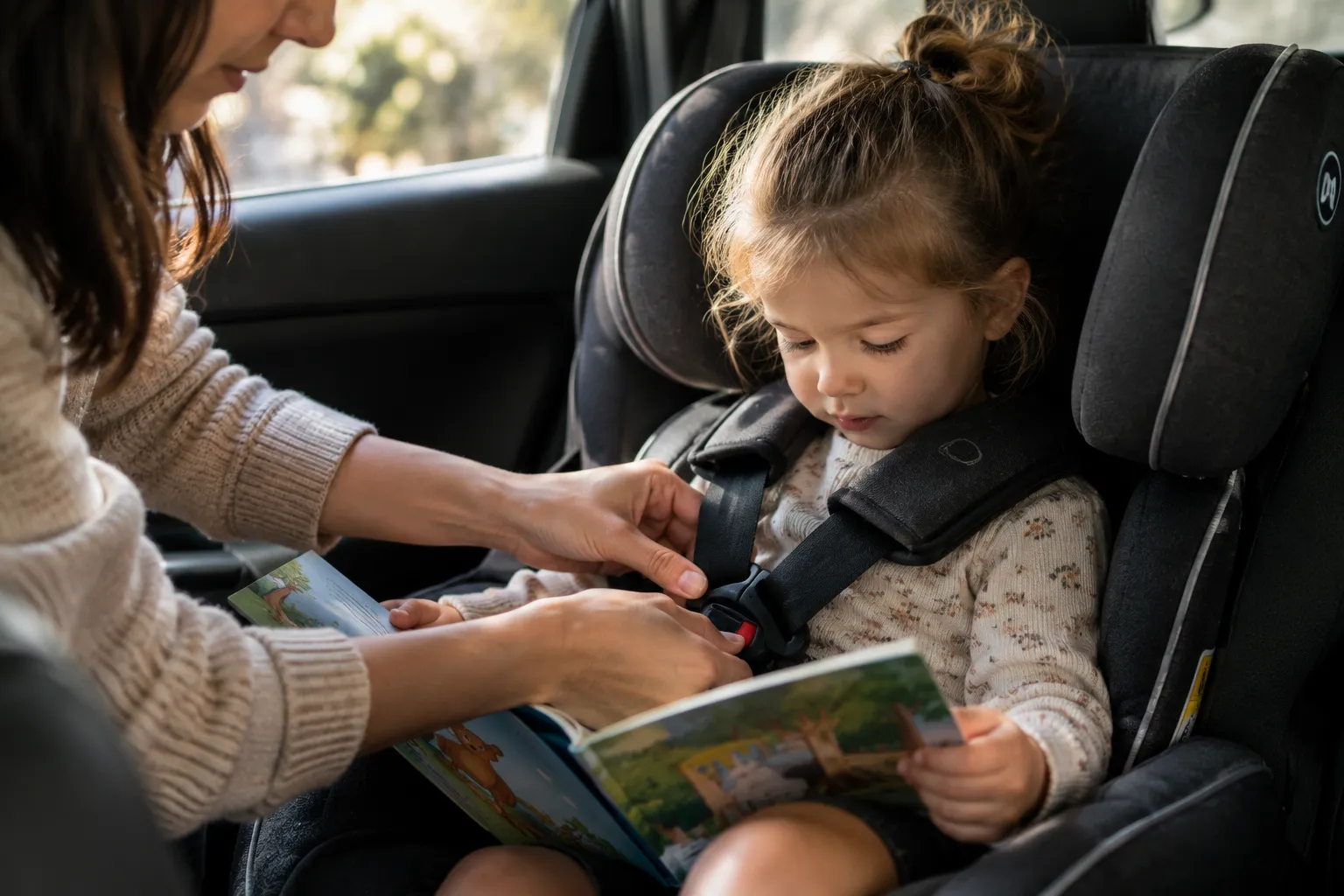
There’s a persistent myth that child restraint rules somehow relax when the car is a rideshare or a booked transfer — that a lap and a firm grip are legal for one short trip to the airport. For a pre-booked transfer in NSW, they are not. The law follows the child, and a professional transfer service is expected to meet it properly. Here’s what the rules actually say, and how to make them painless at 5am.
(The summary below follows the NSW Government’s published rules, checked 12 September 2026. Rules get refined over time — for the authoritative current version, read the NSW Government’s child car seats page before you travel.)
What car seat does my child need in NSW?
It depends on age: a rear-facing seat under 6 months; a rear-facing seat or a forward-facing seat with an inbuilt harness from 6 months to 4 years; a harnessed forward-facing seat or an approved booster from 4 to 7; and from 7, a booster until they are tall enough for an adult seatbelt. In more detail:
- Under 6 months: an approved rear-facing restraint. No exceptions.
- 6 months to under 4 years: an approved rear-facing or forward-facing restraint with an inbuilt harness. Rear-facing remains the safer option for as long as the child fits it.
- 4 to under 7 years: an approved forward-facing restraint with an inbuilt harness, or a booster seat. A standard adult belt alone is not legal yet.
- 7 and over: a child who is too small for a seatbelt should use an approved booster seat or an anchored safety harness. The suggested minimum height for an adult seatbelt is 145 cm, and many 7- and 8-year-olds are shorter than that.
The driver is responsible for making sure every child under 7 is secured in an approved restraint suitable for their age and size.
Age bands are the legal floor, not a graduation ceremony. The safest practice is to move to the next restraint stage only when the child physically outgrows the current one — the markers on modern seats show exactly when that is.
Can my child sit in the front seat?
Not if they are under 4 and the vehicle has two or more rows of seats. From 4 to under 7, only if the seats in the back row are already taken by other children under 7.
Do the child seat rules apply in a booked transfer?
Yes — in full, exactly as they do in your own car. That’s not a burden; it’s the point of pre-booking. You declare each child’s age when you request your quote, and the right seats are fitted before the vehicle arrives, not on your kerb while everyone’s patience runs out.
Taxis are different. NSW has separate rules for taxis: a child up to 6 months still needs a rear-facing seat, and a child aged 6 to 12 months a rear-facing seat or a forward-facing seat with an inbuilt harness, but a child over 12 months may use a booster seat or a properly adjusted and fastened seatbelt. A suitable seat is not guaranteed to be in the taxi that turns up, or in the rideshare car either — and for an airport run with a fixed departure time, that gamble has a bad risk-reward.
The honest capacity note: a fitted child seat occupies a full passenger seat. A seven-seat people mover carrying two child seats and a booster is a seven-seat vehicle with three seats spoken for. Any transfer service doing this properly counts restraints in the capacity check — if a quote form doesn’t ask children’s ages, that’s a signal about how seriously the rest is taken.
What should I tell the transfer company when I book?
Every child’s age, and whether you’re bringing your own seat. The checklist:
- Declare every child and their age when you request your quote — it drives both the legal restraint type and the vehicle recommendation.
- Pick the restraint stage that matches the child, not the birthday. Between sizes? Note it in your request; the safer (earlier) stage wins.
- Count the pram and the luggage too. Family trips fill vehicles fast; honest declarations up front beat kerbside Tetris.
- Using your own seat? That works as well — tell the service, and the driver fits or accommodates it. Your own seat also solves the destination leg if you’re hiring a car later.
- For the return trip, book the seats again. The restraint requirement doesn’t lapse because everyone’s tired and tanned.
Why do child seats matter more on an early airport run?
Because airport runs stack up the conditions that make a badly fitted seat dangerous: a pre-dawn start, a tired parent doing the fitting, and motorway speeds for much of the trip. Correctly fitted restraints reduce the risk of serious injury in a crash — that’s why the law exists — and the fitting matters nearly as much as the seat itself. A harness threaded wrong or an anchor left loose gives away much of the protection. It’s precisely the job you don’t want done hastily in the dark by a parent holding a boarding pass in their teeth.
Our approach is simple: child seats are selected when you request your quote, priced as clear line items, and fitted before pickup. The 5am start stays calm, and the fine print stays satisfied.
So what do I actually need to do?
Book the seats when you book the car. Under seven means an approved restraint in NSW — in a transfer vehicle just like the family car. Declare ages honestly, and let the service do the fitting. It’s one of the few parts of family travel that can be genuinely solved before the day begins.
Planning the arrival end too? Our Sydney Airport pickup guide covers meeting your driver, including meet & greet for landing with kids.